The Most Revealing Gilmore Girls Love Stories Began After the Romantic Moment
Why Gilmore Girls Was Better at Showing the Mess After “I Love You”
Romance on Gilmore Girls is often remembered through moments of anticipation.
Who will finally kiss? Who will choose whom? Who will propose? Which relationship will survive?
But the series becomes more interesting when you stop looking at the beginning of relationships and start looking at what happens after people make the big emotional choice.
Because Gilmore Girls understood something television romance sometimes avoids:
Choosing someone is only the beginning. Living with that choice is the difficult part.
A proposal can be simple. Building a marriage cannot.

Sookie and Jackson’s proposal works because it is almost startlingly direct.
There is no elaborate speech. No sweeping public performance. Jackson simply moves toward the question that has been sitting underneath their relationship.
And Sookie’s reaction is exactly what makes the moment feel like Gilmore Girls. She panics. She misunderstands. She jumps to another explanation before finally realizing what he means.
It is romantic, but it is also awkward.
That combination matters.
The show rarely lets love become too polished. Even one of its happiest relationship milestones arrives through confusion, nervousness, and comedy.
And that is a pretty honest preview of commitment.
Marriage does not magically turn two imperfect people into calm, perfectly synchronized partners. It simply gives those imperfections a shared address.
Sookie and Jackson remain themselves after the proposal.
That is the point.
Lorelai’s relationships become most revealing after the fantasy breaks
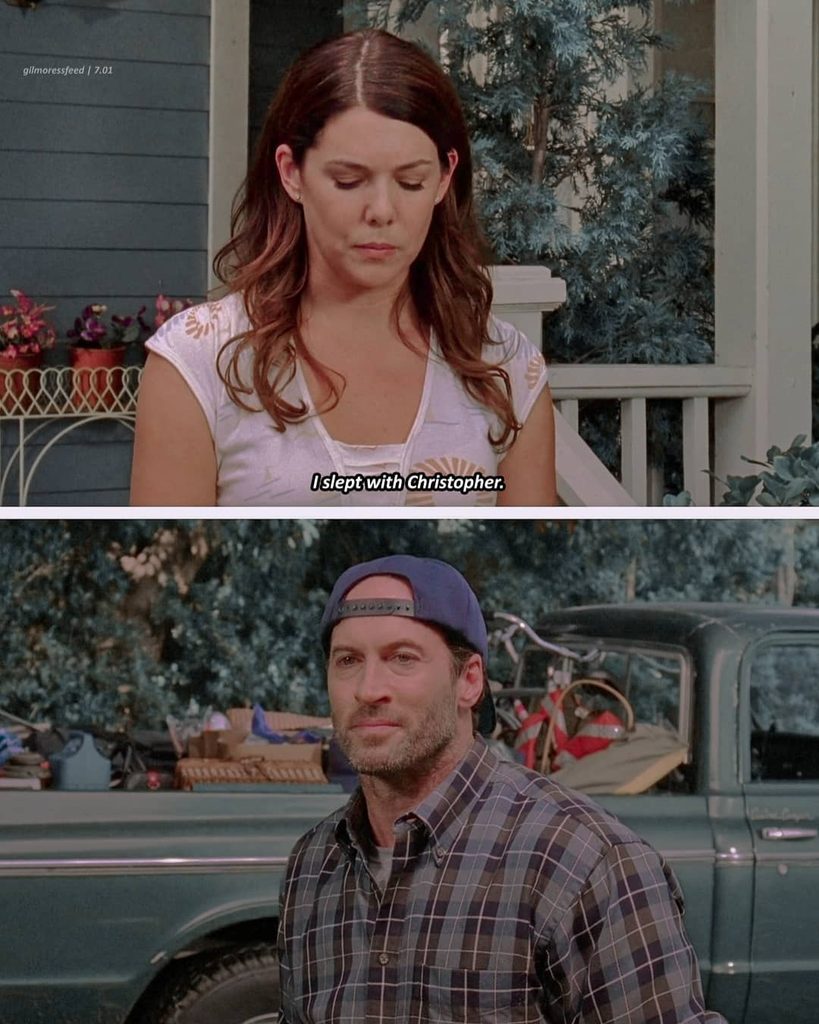
Few relationship scenes in the series are as emotionally stripped down as Lorelai telling Luke that she slept with Christopher.
There is almost nothing romantic left to hide behind.
No banter.
No charming detour.
No Stars Hollow absurdity.
Just a painful truth sitting between two people who have already accumulated years of hope, frustration, friendship, and love.
On a first watch, it is easy to focus on the shock of the confession.
On a rewatch, what stands out is how much history is compressed into the silence around it.
Lorelai and Luke’s relationship was never difficult because they lacked feeling.
They had plenty of feeling.
Their real problem was that neither of them was especially good at handling uncertainty without eventually turning it into damage.
Luke withdrew.
Lorelai endured.
Then Lorelai acted.
The confession is devastating because it is not simply about Christopher. It is about what happens when unresolved emotional pressure finally breaks through whatever structure was holding it in.
That is a much more adult relationship story than a simple triangle.
Love does not protect people from terrible timing
Lorelai’s romantic life repeatedly demonstrates how much timing matters.
You can love someone and still reach them at the wrong moment.
You can understand someone deeply and still communicate badly.
You can want stability so badly that you become impatient with the process required to create it.
And you can make one decision in a moment of emotional collapse that changes how another person sees everything that came before it.
That is why the series’ relationships remain debatable.
They are not mathematical equations.
The show does not always give viewers a clean villain.
Instead, it often gives us people who are right about one thing, wrong about another, and emotionally exhausted by the time they have to decide what comes next.
Paris proves that even supposedly “rational” people are chaotic in love

Paris is one of the most controlled characters in the entire series.
She plans.
She competes.
She interrogates.
She assumes there is always a correct answer if she pushes hard enough.
Then love enters the equation.
Suddenly the same person who can dominate an academic or professional room becomes suspicious, vulnerable, reactive, and intensely human.
Her conversation with Rory about Doyle works because it exposes the limitation of Paris’s worldview.
Relationships cannot be managed like an application, a debate, or a career strategy.
There is no perfect spreadsheet for trust.
No achievement guarantees emotional security.
Paris can analyze everybody else endlessly and still be terrified when her own relationship becomes uncertain.
That contradiction makes her romantic story far more interesting than simply asking whether she and Doyle “belong together.”
Commitment is really about what happens on ordinary days

Luke cooking in a kitchen while negotiating with a dog may seem completely unrelated to the dramatic relationship scenes elsewhere in the series.
But emotionally, it belongs in the same conversation.
This is commitment in its least glamorous form.
Food.
A kitchen.
A ridiculous private routine.
Talking to an animal as though the animal is a difficult roommate.
This is the side of love that dramatic television often skips.
Relationships are built from thousands of tiny negotiations that nobody outside the relationship ever sees.
Who feeds the dog?
Who makes dinner?
Who gets annoyed?
Who apologizes?
Who knows exactly how the other person behaves when tired, frightened, hungry, or angry?
Grand gestures can begin relationships.
Domestic knowledge is what eventually gives them texture.
That may be why Gilmore Girls romances remain so debatable
The show gives viewers plenty of romantic moments.
But its best relationship writing usually happens when romance stops being the entire point.
A proposal becomes a marriage.
A friendship becomes a partnership.
A fight becomes a choice.
A confession becomes a consequence.
A relationship becomes part of someone’s daily life.
That is where the fantasy ends.
And that is where the real story begins.
Gilmore Girls understood that commitment is not simply saying yes to someone.
It is waking up afterward and continuing to choose the life that “yes” created.
Sometimes the characters managed that beautifully.
Sometimes they failed spectacularly.
But they almost always felt human while trying.
Which Gilmore Girls relationship do you think handled real commitment best—and which one struggled most once the romantic fantasy became everyday life?