- The Secret to Gilmore Girls’ Comfort Was Never the Plot
- Why a Wave Through Luke’s Window Can Feel More Emotional Than a Big Speech
- Gilmore Girls Made Ordinary Life Feel Worth Watching
Ask fans why they return to Gilmore Girls, and the answer is rarely just the plot.
Many already know what happens.
They know the relationships.
The breakups.
The college decisions.
The weddings.
The fights.
Yet they return.
Why?
Because Gilmore Girls created something more powerful than suspense.
It created familiarity.
The feeling that you know where the coffee is.
Who will be behind the counter.
Who will complain.
Who will interrupt.
Who will organize another ridiculous town event.
And who will wave when you walk past the window.
Sometimes an entire relationship fits inside one wave

Luke is inside the diner.
Lorelai is outside.
They see each other.
They raise their hands.
That is it.
No dramatic declaration.
No swelling speech.
And yet fans who have spent years with these characters can read far more into the moment.
History changes small gestures.
A wave between strangers means almost nothing.
A wave between two people with years of emotional history can carry an entire relationship.
That is how comfort television works
Repetition stops feeling repetitive.
It becomes ritual.
Luke’s diner.
Coffee.
The gazebo.
Town meetings.
Friday night dinner.
Yale.
Phone calls.
Random festivals.
We know these spaces.
The familiarity lowers the emotional distance between viewer and fictional world.
Eventually you are not watching Stars Hollow.
You are returning to Stars Hollow.
Even coffee becomes part of the language

Rory ordering an expensive coffee and slowly removing every extra because of the price is a small scene.
No major plot turns.
Nobody’s life changes.
But it is memorable because Gilmore Girls understands how character can live inside an ordinary transaction.
Coffee is never just coffee in this universe.
It can represent comfort.
Routine.
Money.
Adulthood.
Friendship.
Exhaustion.
Independence.
And occasionally very poor budgeting.
Lorelai turns community events into performance
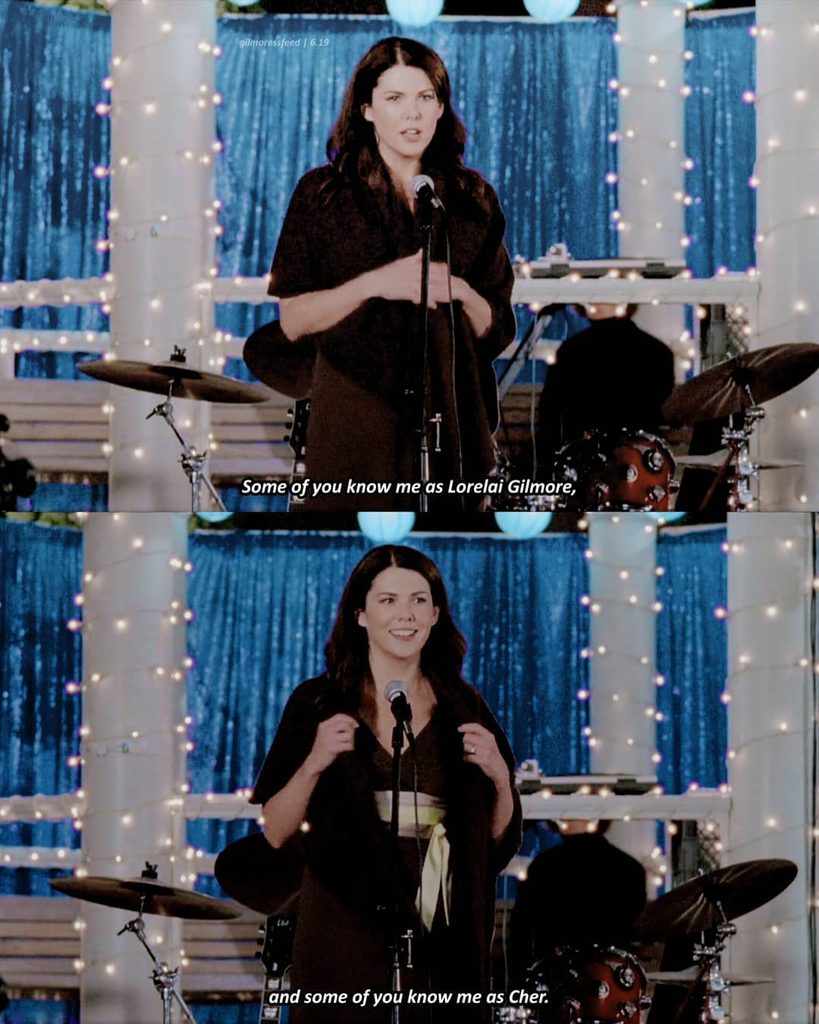
“Some of you know me as Lorelai Gilmore…”
“And some of you know me as Cher.”
Of course.
Only Stars Hollow can make a community event feel simultaneously unnecessary and essential.
The town constantly creates reasons for everyone to be in the same place.
Festivals.
Fundraisers.
Competitions.
Meetings.
Celebrations.
Performances.
From a plot perspective, half of these events are unnecessary.
From a world-building perspective, they are everything.
A believable fictional town needs useless moments
Real communities are not composed only of major life events.
They contain waiting.
Eating.
Shopping.
Complaining.
Small talk.
Inside jokes.
Seeing the same people repeatedly.
That is exactly what Gilmore Girls gives viewers.
The “filler” is often the point.
Stars Hollow makes adulthood feel communal
Many adult lives become fragmented.
Work somewhere.
Sleep somewhere else.
Order food from strangers.
Drive past people you do not know.
Stars Hollow offers the opposite fantasy.
The coffee guy knows your order.
The neighbors know your business.
The town knows who you date.
People show up when something happens.
That lack of privacy would probably become maddening in real life.
On television, it can feel deeply comforting.
The characters become part of the architecture
Luke is not merely a character.
He is part of Luke’s Diner.
Taylor becomes inseparable from town bureaucracy.
Kirk can appear almost anywhere because the show turns him into a human extension of Stars Hollow itself.
Miss Patty.
Babette.
The troubadour.
Recurring faces create continuity.
We are not meeting new people every episode.
We are watching familiar people continue existing.
Even chaos becomes predictable
A deer hits Rory’s car.
A town event goes wrong.
A coffee order becomes absurd.
Someone misunderstands something.
Luke complains.
Lorelai jokes.
The specific event changes.
The emotional rhythm remains familiar.
That rhythm is why rewatching works.
Comfort comes from knowing the world will still be there
The episode ends.
The problem is resolved—or not.
But Luke’s will open again.
Coffee will be poured again.
Someone will walk across the town square.
Lorelai will make another joke.
That continuity creates safety.
Maybe that is why Gilmore Girls survives endless rewatches
You do not always return because you forgot what happened.
Sometimes you return precisely because you remember.
You know the road.
You know the diner.
You know the people.
And for forty-something minutes, the fictional town behaves like a place that remembers you too.
What single Gilmore Girls location feels most like “home” to you—Luke’s, Lorelai’s house, Yale, or somewhere else?