- Why the Funniest Gilmore Girls Lines Usually Hide Something Serious
- Gilmore Girls Characters Joke Most When They’re Least Comfortable
The characters on Gilmore Girls are rarely incapable of speaking.
Quite the opposite.
They can talk about almost anything for an extraordinary amount of time.
Pop culture.
Food.
Clothes.
Coffee.
Town events.
Books.
Family.
Relationships.
And yet when something emotionally dangerous enters the conversation, direct language often disappears.
In its place comes sarcasm.
Jokes.
References.
Deflection.
Mock outrage.
That is one of the cleverest things about the show’s dialogue.
The jokes are not interruptions to the emotional story.
Very often, the joke is the emotional story.
Lorelai turns awkwardness into material

Lorelai appears wearing something questionable and asks Rory for advice.
Rory could simply say yes or no.
Instead, she gives the arts-and-leisure joke.
That exchange tells us instantly how these two people relate.
Rory is comfortable teasing her mother.
Lorelai expects teasing.
Neither interprets sarcasm as rejection.
In their relationship, mockery can actually signal intimacy.
That is why Gilmore Girls dialogue feels different from generic sitcom banter.
The jokes are specific to the relationships.
Jess flirts through argument

“Did you at least think it was funny?”
The question is doing several jobs.
Jess wants validation.
He is provoking Rory.
He is flirting.
He is trying to pull her onto his side without directly asking whether she likes him.
Rory’s denial becomes part of the game.
This is how chemistry works on Gilmore Girls.
Characters often do not say:
“I like talking to you.”
They create a conversation that proves it.
That is much more satisfying.
Emily uses seriousness so aggressively it becomes comedy
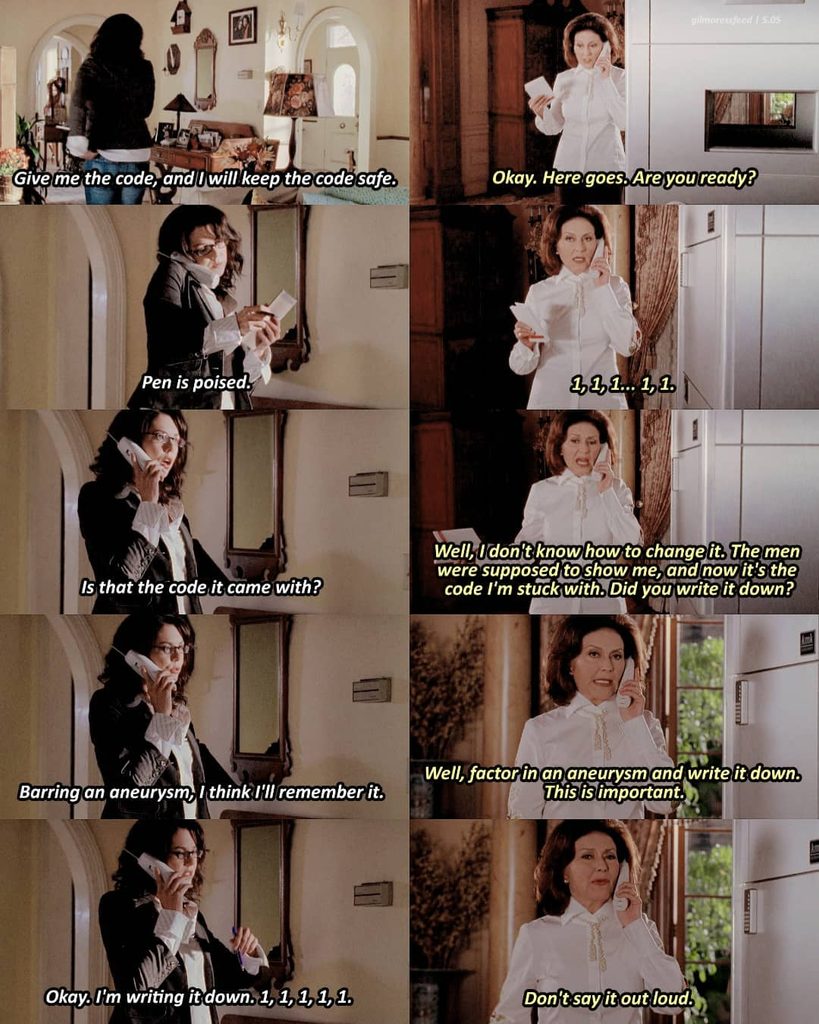
A security code should be simple.
With Emily, it becomes a mission.
Write it down.
Protect it.
Take this seriously.
Do not say it out loud.
Lorelai responds in the only way Lorelai knows how:
by making the seriousness even more absurd.
The scene is funny because neither woman changes style.
Emily increases control.
Lorelai increases humor.
That is their entire relationship compressed into one mundane task.
Lorelai uses jokes to survive Emily’s emotional world

The “maybe he was just happy to see you” response is classic Lorelai.
Emily presents something alarming.
Lorelai hears an opportunity for a joke.
Why?
Because joking gives Lorelai control over the tone.
Emily can create discomfort.
Lorelai can turn discomfort into comedy.
That dynamic appears again and again.
Humor is not merely Lorelai’s personality.
It is one of her defenses.
If she can make something funny, she can create emotional distance from it.
The funniest exchanges often happen when characters interpret the same situation differently

“A complete disaster.”
“My existence?”
“No, not everything is about you.”
This is funny because Lorelai’s assumption is ridiculous.
It is also emotionally logical.
Years of tension have trained her to expect Emily’s criticism to be about her.
So the punchline comes from history.
That is an important distinction.
Good dialogue gives you a joke.
Great character dialogue gives you a joke that would only work between those two people.
Gilmore Girls does that constantly.
Luke’s understatement is the opposite of Lorelai’s excess
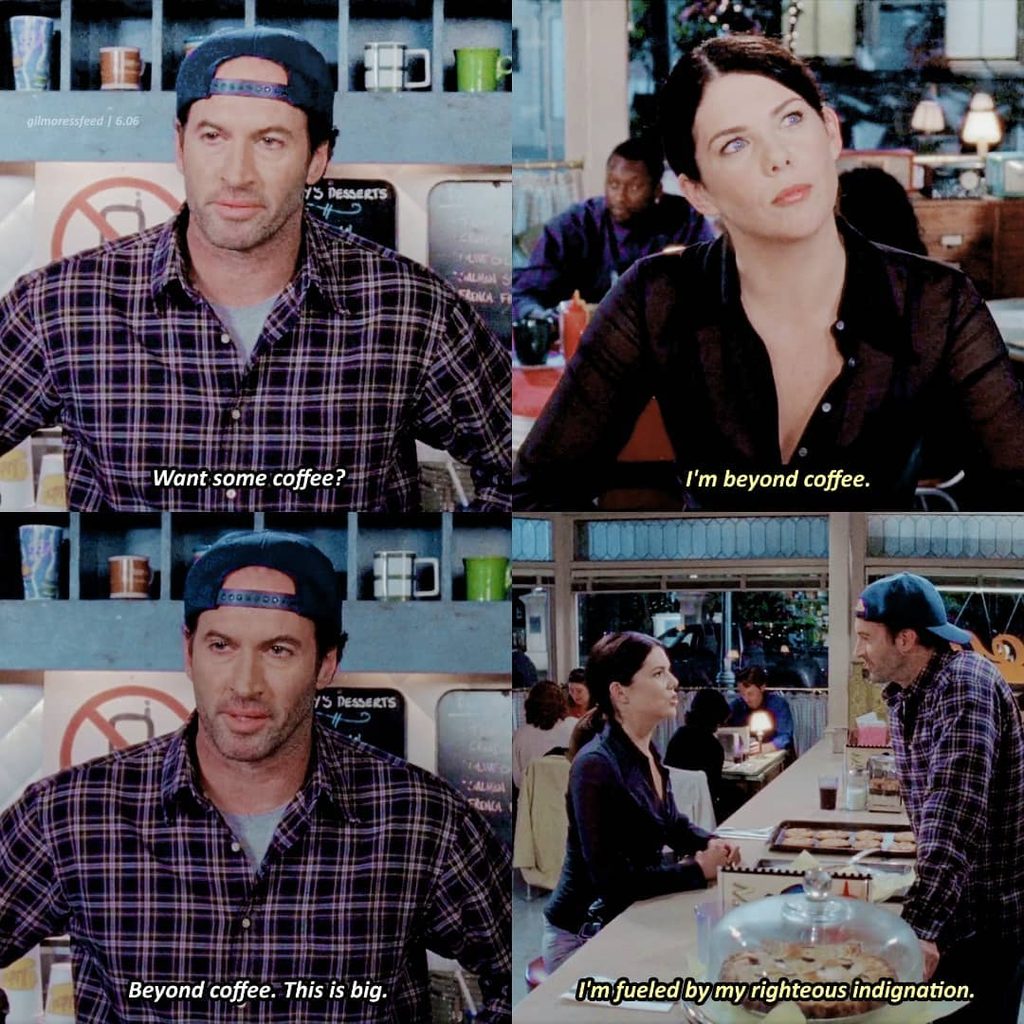
Lorelai is “beyond coffee.”
Luke understands immediately that something is serious.
This exchange works because viewers know their normal rhythm.
Coffee usually solves everything.
If coffee is no longer enough, the problem has reached a new level.
Luke does not need a monologue.
His reaction tells us he understands the code.
This is another reason the dialogue feels alive:
Characters build private languages over time.
For Luke and Lorelai, coffee is part of that language.
Sarcasm works because the audience learns the translation
By the time you have watched several seasons, you know what these people mean when they say something completely different.
Lorelai jokes:
She may be scared.
Emily criticizes:
She may feel excluded.
Luke complains:
He may be worried.
Paris lectures:
She may be anxious.
Rory uses dry humor:
She may be trying to keep an uncomfortable moment manageable.
The literal sentence is only half the conversation.
That is why rewatching the series remains rewarding.
You start hearing the translation underneath the line.
The show becomes emotional when the joke stops
This is perhaps the most important result of all that humor.
When characters finally speak directly, it matters.
When Lorelai stops joking.
When Luke says exactly what he means.
When Rory cannot hide behind a clever response.
When Emily admits pain without wrapping it in criticism.
Those moments land because the show has trained us to expect avoidance.
Directness becomes dramatic.
Silence becomes dramatic.
That is sophisticated writing.
The fast dialogue is fun.
The references are fun.
But the deeper achievement is that every character has a different way of avoiding vulnerability.
And Gilmore Girls turns those defenses into entertainment without making them meaningless.
That is why the funniest lines can also be the most revealing.
Sometimes sarcasm is not the opposite of honesty.
Sometimes it is the only kind of honesty a character is ready to offer.
Which Gilmore Girls character hid their feelings behind humor the most: Lorelai, Emily, Luke, Paris, Rory—or someone else?