“Soulmate” is a dangerous word.
It can make love sound effortless.
Predetermined.
Perfect.
As though somewhere in the world there is one person who will understand everything about you immediately and never make your life difficult again.
Luke and Lorelai are almost the opposite of that fantasy.
They misunderstand each other.
Frustrate each other.
Miss opportunities.
Date other people.
Hurt each other.
Separate.
Reconnect.
And somehow that makes the soulmate argument stronger rather than weaker.
Because their relationship is never based on perfection.
It is based on recognition.
A soulmate can begin as a best friend

Luke and Lorelai’s relationship spends years living in the space between friendship and romance.
That space is exactly what makes it believable.
Before the big kiss, Luke already knows Lorelai’s habits.
Before the proposal, Lorelai already knows Luke’s moods.
Before either can confidently imagine marriage, they have already experienced ordinary life together.
That matters.
Romantic chemistry can appear quickly.
Deep familiarity cannot.
They become part of each other’s infrastructure
Luke is not merely someone Lorelai dates.
He becomes woven into how her life functions.
The diner.
Coffee.
Repairs.
Food.
Town events.
Rory.
Emergencies.
Celebrations.
Bad days.
Likewise, Lorelai becomes part of Luke’s emotional landscape long before he openly acknowledges the importance of that fact.
You can remove a boyfriend from a schedule.
It is much harder to remove someone who has become part of the architecture of your day.
Knowing someone is different from idealizing them

There is a reason the idea of “the person who knows you better than anyone else” feels especially appropriate for Luke and Lorelai.
They have seen the unpolished versions.
Luke knows that Lorelai can be irresponsible.
Lorelai knows Luke can become impossible when he shuts down.
Neither is discovering a perfect stranger.
They are choosing someone whose flaws are already familiar.
That can be more frightening than falling for an ideal.
It can also be more durable.
They do not rescue each other from being themselves
Many romances are built around transformation.
A character meets “the one” and becomes an entirely different person.
Luke and Lorelai do change.
But they remain recognizably themselves.
Luke is still Luke.
Lorelai is still Lorelai.
The relationship does not erase their identities.
Ideally, it gives those identities more room to grow.
They make each other better without becoming each other

Luke introduces stability into Lorelai’s life.
Not control.
Stability.
He is reliable where she is spontaneous.
Practical where she is impulsive.
Grounded where she can become emotionally chaotic.
Lorelai gives Luke movement.
Noise.
Community.
Risk.
Emotion.
A life larger than the routines he sometimes uses to protect himself.
Neither one needs the other to become complete.
But both challenge the other’s default settings.
That is a healthier version of “you make me better”
Making someone better should not mean correcting their personality.
It should mean expanding what feels possible.
Luke gives Lorelai a relationship that does not have to be built around unpredictability.
Lorelai gives Luke reasons to step outside isolation.
Sometimes they resist those changes.
Sometimes they fail badly.
But the influence is visible.
Acceptance matters more than compatibility

Luke and Lorelai are not obviously compatible on paper.
She loves noise.
He loves quiet.
She talks through discomfort.
He retreats from it.
She embraces absurdity.
He distrusts anything that cannot be explained practically.
Yet compatibility is not only about similarity.
Sometimes it is about whether two people understand the differences well enough to live beside them.
Luke knows Lorelai is going to talk.
Lorelai knows Luke is going to complain.
And much of the time, both secretly enjoy exactly what they pretend to find irritating.
Their friendship protects the romance
Romance changes.
Attraction changes.
Life becomes messy.
But Luke and Lorelai always have something underneath it:
They actually like each other.
That sounds obvious.
It is not.
They can share mundane time.
They can stand in kitchens.
Sit on porches.
Argue about food.
Do absolutely nothing cinematic.
And still feel like themselves.
That is the best-friend part of the relationship.
“Forever” means something different when you know the whole person
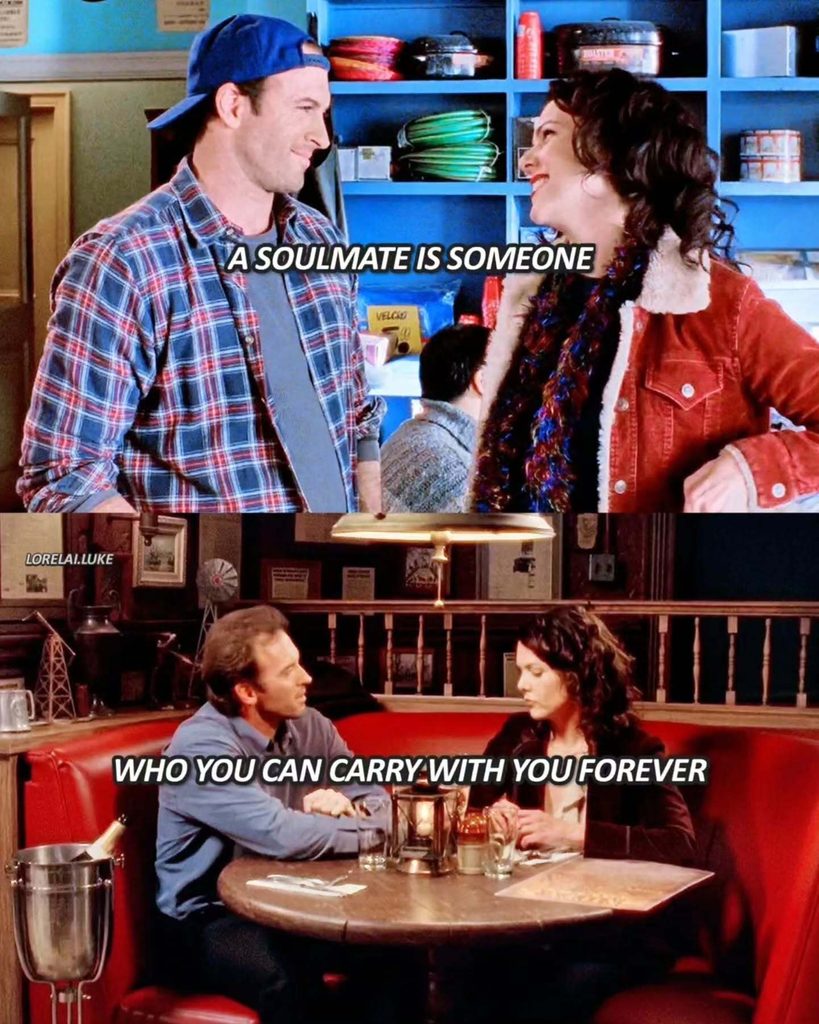
The romantic fantasy of forever usually focuses on the future.
Luke and Lorelai make it powerful because of the past.
They already have years behind them.
Memories.
Mistakes.
History.
They know what staying costs.
So the idea of carrying someone with you forever becomes less sentimental and more substantial.
They know exactly who that person is.
The soulmate idea works because their relationship survives disillusionment
At some point every romantic ideal meets reality.
Luke fails Lorelai.
Lorelai fails Luke.
Neither remains an imagined perfect partner.
And yet the attachment survives.
Not unchanged.
Not unhurt.
But alive.
Maybe that is the more useful definition of a soulmate.
Not someone who never disappoints you.
Someone you continue to recognize even after the fantasy disappears.
Luke and Lorelai are not proof that soulmates exist
They are something more interesting.
They are proof that love can grow from friendship, familiarity, contradiction, disappointment, forgiveness and an enormous amount of coffee.
And perhaps that is why fans keep returning to them.
Not because the relationship is perfect.
Because it feels lived in.
What made Luke and Lorelai feel more like soulmates to you: their romance or the friendship underneath it?