Gilmore Girls is famous for fast dialogue.
But speed alone is not what makes the writing memorable.
The characters use humor strategically.
Lorelai jokes when she feels exposed.
Rory gets dry when she is overwhelmed.
Paris becomes intense when she is uncertain.
Luke complains when he cares.
Emily sharpens her language when she wants control.
That means the funniest lines frequently contain emotional information.
You laugh first.
Then, on a rewatch, you realize what the character was avoiding.
Lorelai turns dependency into a coffee joke

Luke asks how much coffee she has had.
Lorelai’s answer is ridiculous.
That is exactly why it works.
The literal joke is about caffeine.
The emotional detail is that these two people know each other’s routines intimately.
Luke knows she has already had too much.
Lorelai knows he will still eventually give her more.
The entire relationship exists inside the joke.
A weaker show would explain the familiarity.
Gilmore Girls simply lets two people argue about coffee.
Compliments become safer when disguised as banter
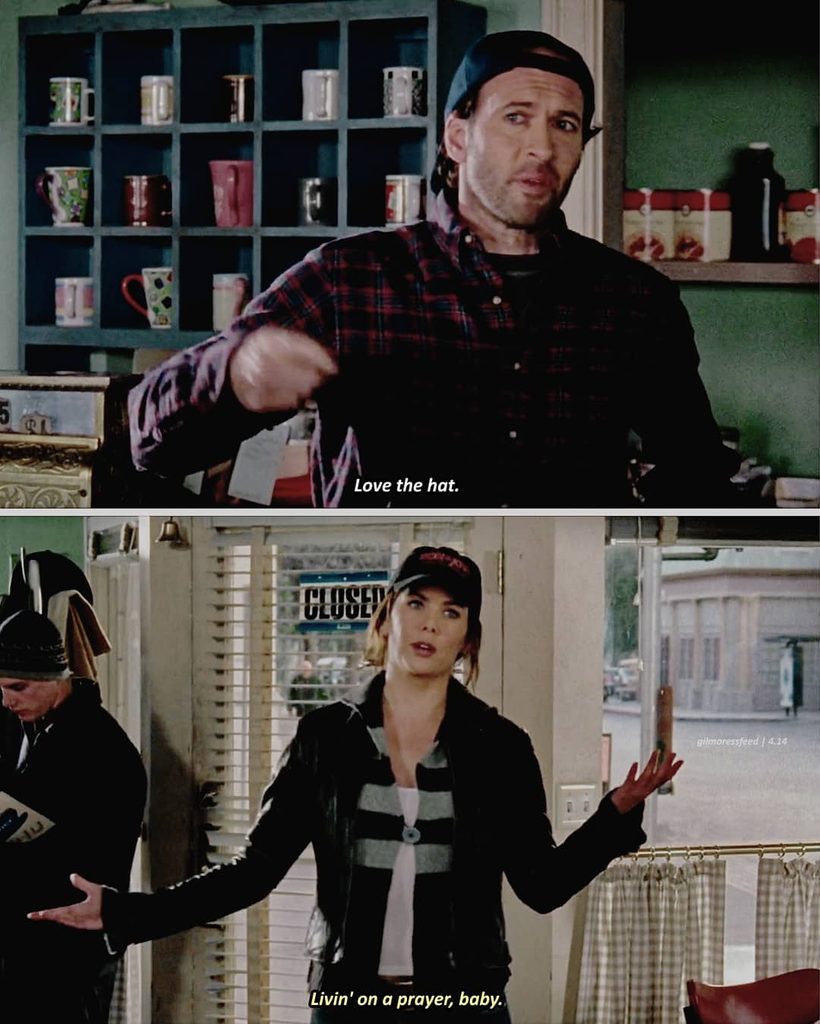
“Love the hat.”
That should be simple.
With Luke and Lorelai, nothing stays simple for long.
A compliment becomes a joke.
The joke becomes an invitation to continue.
Their relationship often works this way.
Neither character has to declare attraction.
They can talk around it indefinitely.
That gives their dialogue a double meaning.
The words say one thing.
The timing says another.
Rory compresses chaos into a single sentence

“I got kissed.”
“And I shoplifted.”
This is one of the funniest ways to summarize an emotionally enormous day.
Rory’s humor differs from Lorelai’s.
Lorelai expands situations until they become absurd.
Rory often does the opposite.
She reduces the absurd situation into a dry statement.
That contrast is part of why their conversations work so well.
They share a comic language without having identical voices.
Paris responds to loneliness by becoming aggressively independent

“No man is an island.”
“But this woman is.”
The joke works because it sounds exactly like Paris.
Nobody else could say it the same way.
Paris takes vulnerability and turns it into a declaration of self-sufficiency.
That is funny.
It is also revealing.
The stronger Paris insists that she can handle everything alone, the easier it becomes to see the insecurity underneath the claim.
This is one of the show’s best tricks.
Character defense mechanisms become punchlines.
Even crisis becomes comedy because Paris refuses normal reactions
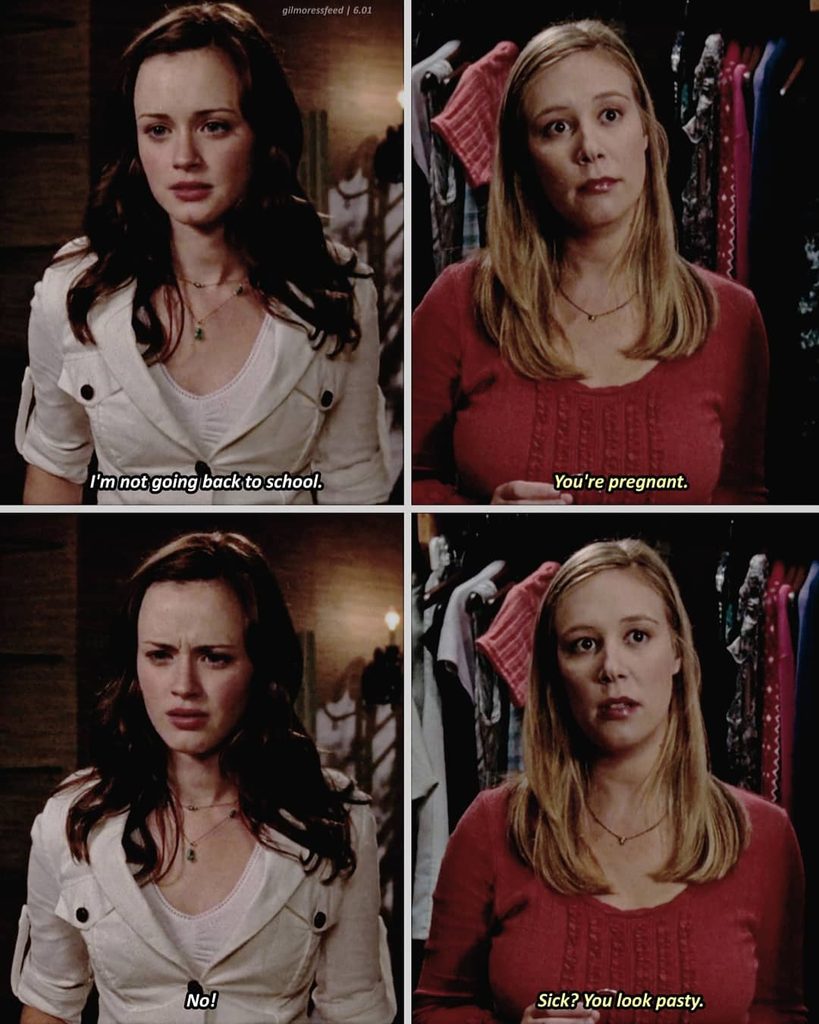
Rory says she is not returning to school.
Paris responds by jumping to pregnancy.
It is absurd.
It is also psychologically perfect for Paris.
A dramatic change must have a dramatic explanation.
The ordinary possibility—that Rory is confused and reconsidering her future—is almost too emotionally ambiguous.
Paris wants causes.
Certainty.
Answers.
So her joke reveals worldview as much as personality.
Emily’s jokes function differently

Emily does not usually create sprawling riffs like Lorelai.
Her humor is sharper.
Cleaner.
More controlled.
A surprise visit becomes a pointed remark.
Emily can acknowledge emotion while still maintaining social form.
That difference is one reason mother-daughter conversations feel so distinct.
Lorelai destabilizes situations with humor.
Emily uses humor to reassert control.
Same tool.
Completely different purpose.
Luke’s irritation frequently means affection
Luke may be the clearest example of dialogue saying the opposite of what the character feels.
He complains.
He objects.
He tells people they are ridiculous.
Then he helps anyway.
That contradiction becomes a language of its own.
The audience gradually learns:
Luke being annoyed does not necessarily mean Luke wants you to leave.
Sometimes it means Luke cares enough to be involved.
The jokes create intimacy because characters understand the code
This matters most in close relationships.
Rory knows when Lorelai is joking instead of answering.
Lorelai understands Luke’s grumbling.
Luke knows Lorelai will exaggerate.
Paris and Rory eventually learn how to survive each other’s verbal styles.
The humor works because there are shared rules.
That is what makes it feel relational instead of merely clever.
The best jokes become emotional subtitles
Once you know the characters, you begin translating automatically.
Lorelai jokes = this may be uncomfortable.
Luke complains = he probably cares.
Paris declares independence = something may be threatening her emotionally.
Rory goes very dry = she is processing something bigger than she wants to admit.
The joke tells you what the character will not.
That is excellent dialogue.
Which is why silence becomes so powerful
In a world where everyone talks constantly, a moment without the joke becomes enormous.
When Lorelai cannot deflect.
When Rory cannot summarize.
When Luke stops complaining.
When Paris loses certainty.
The silence lands because humor has trained us to recognize what emotional protection normally sounds like.
That is why Gilmore Girls dialogue is still so rewarding to rewatch.
The first time, the lines are fast.
The next time, they become clues.
Which Gilmore Girls character hides the most emotion inside humor?