People often describe Gilmore Girls dialogue as fast.
That is true.
But speed is only the surface.
The real reason the dialogue works is that different characters use language for different emotional purposes.
Lorelai jokes to escape discomfort.
Rory uses dry humor to control awkwardness.
Paris uses bluntness to dominate uncertainty.
Emily uses precision to maintain authority.
Luke uses irritation to disguise affection.
That is why even ordinary conversations feel distinct.
You are not just hearing clever writing.
You are hearing personality.
Lorelai turns identity into a joke before anyone else can define her.
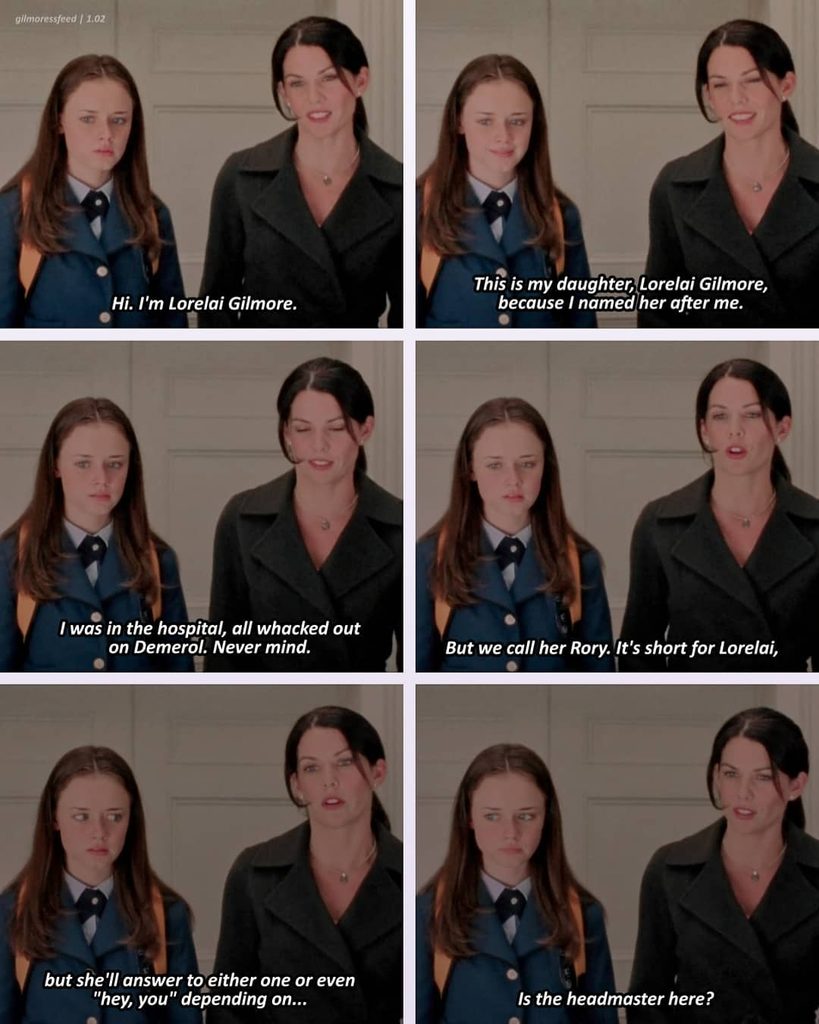
The introduction of Rory’s name is classic Lorelai.
She could simply explain that Rory is also named Lorelai.
Instead, she turns the explanation into a story.
Medication.
Naming logic.
A joke.
Then she keeps moving.
That pattern appears throughout the series.
Lorelai often takes information that could feel emotionally loaded and wraps it in humor before anyone else has time to react.
It is charming.
It is also defensive.
If Lorelai turns the moment into a joke first, she controls the emotional temperature.
Coffee becomes character shorthand.

A normal person is asked whether they like coffee.
A normal person can say yes.
Lorelai cannot.
Her answer becomes a performance.
That is why coffee jokes never feel completely interchangeable with other sitcom jokes.
Coffee is part of Lorelai’s identity.
It represents routine.
Energy.
Comfort.
Excess.
Self-definition.
So when someone asks her about coffee, the show is not only setting up a punchline.
It is giving Lorelai a chance to perform Lorelai.
Rory’s driest moments often happen when she is uncomfortable.
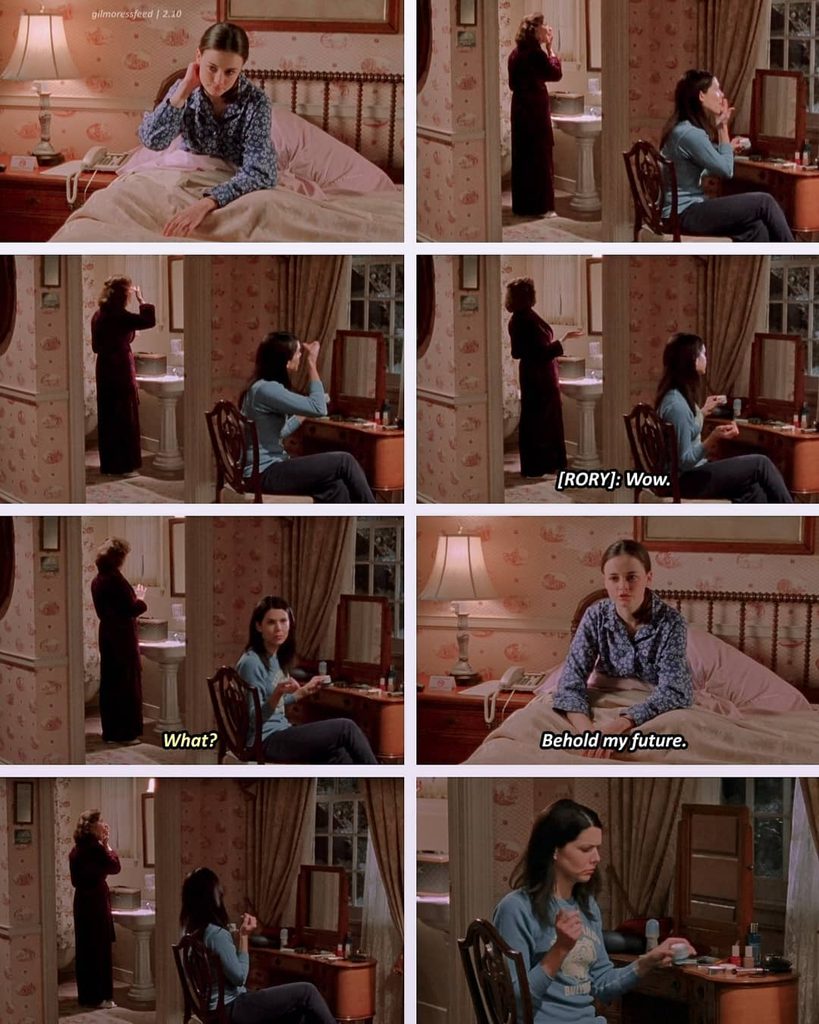
“Behold my future.”
That line works because Rory rarely reacts with the same dramatic energy as Lorelai.
Her humor is drier.
More resigned.
More observational.
She uses jokes to create distance from anxiety.
The viewer laughs because Rory is funny.
But the line also tells us she is worried.
That is good dialogue.
One sentence does two jobs.
Lorelai and Rory create jokes together.

Their racquetball conversation is funny partly because the sport itself becomes secondary.
Rory wants to discuss Luke.
Lorelai would rather discuss almost anything else.
The activity becomes a vehicle for avoidance.
That is typical of their relationship.
They do not simply exchange jokes.
They build jokes together.
One person starts the rhythm.
The other understands the rules.
That shared rhythm creates intimacy.
Paris treats emotion like a hostile negotiation.

Paris rarely uses humor to soften a situation.
She uses language like a weapon.
That is why she is so funny.
She is intense in moments where another character might hesitate.
Friendship conflicts become declarations.
Competition becomes warfare.
Even vulnerability can sound aggressive.
The comedy comes from the mismatch between emotional situation and verbal force.
Paris does not know how to be casual.
And because she does not know how to be casual, almost everything she says sounds unmistakably Paris.
Even friendship reconciliation remains sharp.

The graduation exchange between Rory and Paris is a perfect example.
They acknowledge how much they once disliked each other.
Then they hug.
A more sentimental show might give them a long speech about friendship.
Gilmore Girls keeps the edge.
That is why the moment feels earned.
The characters do not suddenly become different people because the scene is emotional.
They remain themselves.
Sharp.
Awkward.
Affectionate.
Funny.
That consistency makes emotional moments stronger.
Humor is often a form of control.
Once you notice it, many of the show’s funniest lines reveal what a character is trying to manage.
Lorelai manages discomfort.
Rory manages anxiety.
Paris manages uncertainty.
Emily manages social order.
Luke manages tenderness.
Humor is not decoration.
It is strategy.
That is why the dialogue remains interesting on a rewatch.
The first time, you hear the joke.
The second time, you hear what the joke is protecting.
And sometimes that hidden emotional layer is much more revealing than the punchline itself.
The show’s real achievement was character-specific language.
Lots of television shows have witty scripts.
Far fewer give each character a recognizable emotional grammar.
On Gilmore Girls, you can often tell who is speaking before you even see them.
That is not just because of vocabulary.
It is because each character wants something different from language.
Lorelai wants freedom.
Emily wants control.
Paris wants certainty.
Rory wants composure.
Luke wants the conversation to end before he accidentally reveals too much.
That is why the show still sounds alive.
The characters do not merely speak quickly.
They speak like themselves.
Which Gilmore Girls character has the most instantly recognizable way of speaking?