The heart of Gilmore Girls has always been family.
Not perfect family.
Not easy family.
Not even particularly peaceful family.
The power of the show comes from watching generations of women who care deeply about one another while repeatedly failing to express that care in a way the other person can receive.
Emily loves through structure.
Lorelai loves through freedom.
Rory grows up caught between both.
That is why so many family scenes feel funny and painful at the same time.
Everyone is trying.
They simply keep using different emotional languages.
Lorelai wanted Rory’s identity to feel like her own.

The early introduction where Lorelai explains that Rory is actually named Lorelai is played for laughs.
Of course it is.
Lorelai can barely introduce herself without turning the moment into a bit.
But even that joke contains something important about their relationship.
Rory inherits Lorelai’s name, but Lorelai spends years trying not to force Rory into her own life.
That tension is fascinating.
She gives her daughter the same name.
Then spends Rory’s entire childhood insisting that Rory should have more choices than she did.
Lorelai wants closeness without control.
That is a beautiful goal.
It is also much harder than it sounds.
Emily believes family love should look organized.

Emily and Richard operate inside a completely different emotional system.
There are rooms to reserve.
Events to attend.
Standards to maintain.
Problems to solve.
From Lorelai’s perspective, that world often feels controlling.
From Emily’s perspective, it feels responsible.
That distinction matters.
Emily does not wake up thinking, “How can I make Lorelai miserable today?”
She often believes she is creating stability.
The problem is that Emily’s version of stability frequently comes with instructions.
And Lorelai, who built her identity around escaping instructions, experiences that love as pressure.
That is one of the central tragedies of their relationship.
Emily gives care in the form Lorelai rejects most strongly.
Rory becomes the bridge between worlds.

Rory’s graduation scenes reveal something that becomes increasingly important as the series continues.
Rory can move between Lorelai’s world and her grandparents’ world more comfortably than Lorelai ever could.
She can appreciate Richard’s pride.
She can accept Emily’s ceremony.
She can still understand Lorelai’s discomfort.
That makes Rory a bridge.
But bridges carry weight.
Rory is often asked, implicitly or explicitly, to absorb tension that existed long before she was born.
She is loved by all sides.
She is also pulled by all sides.
That is why Rory’s family role becomes complicated even when everyone has good intentions.
Lorelai’s greatest fear is not becoming Emily—it is repeating the feeling Emily gave her.

Scenes where Lorelai and Rory sit together in uncertainty are some of the most revealing in the series.
Lorelai wants to be different from Emily.
Not just in style.
In emotional experience.
She does not want Rory to feel managed.
She does not want Rory to feel trapped.
She does not want Rory to believe love must be earned through compliance.
But the difficulty is that parenting eventually requires boundaries.
And boundaries can feel dangerously close to control.
That is where Lorelai’s confidence often breaks down.
She knows what kind of mother she does not want to be.
She is sometimes less certain what to do when friendship is not enough.
Family rituals reveal both love and pressure.
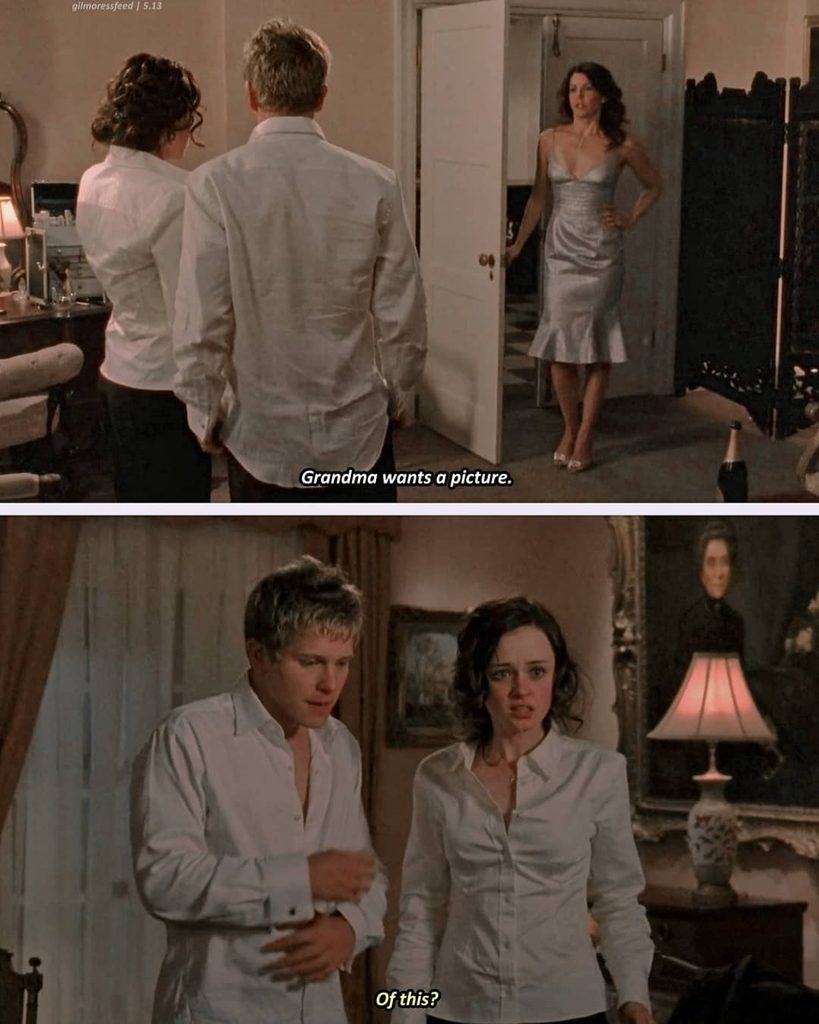
Formal occasions on Gilmore Girls are rarely just decorative.
Clothing matters.
Pictures matter.
Introductions matter.
Tradition matters.
And beneath all of it is the question of who gets to define what the family should look like.
Emily sees rituals as proof of continuity.
Lorelai often sees them as performances.
Rory sometimes sees both.
That is why these scenes can feel uncomfortable even when everyone is technically celebrating.
Love is present.
So is expectation.
The two are constantly intertwined.
The family’s greatest problem is not lack of love.
That may be the single most important thing about the Gilmores.
They love each other.
Deeply.
Often badly.
Emily’s problem is not indifference.
Lorelai’s problem is not ingratitude.
Rory’s problem is not selfishness.
Their conflicts come from competing ideas of what love is supposed to do.
Emily believes love protects through structure.
Lorelai believes love protects through freedom.
Rory grows up having to decide which parts of each model she wants to keep.
And because none of them are entirely wrong, the conflict never becomes simple.
That is why Gilmore Girls remains emotionally rich.
It is not a story about a good generation replacing a bad one.
It is a story about people inheriting emotional habits and trying, with mixed success, to improve them.
Understanding your parents does not mean agreeing with them.
That is where the show becomes especially powerful on a rewatch.
As a teenager, Emily can seem impossible.
As an adult, Lorelai can seem reactive.
As a parent, both women can become understandable at the same time.
That does not erase harm.
It adds context.
And context is often what adulthood gives us.
The Gilmore women never completely stop misunderstanding one another.
But they keep returning.
To dinners.
To graduations.
To crises.
To jokes.
To arguments.
To each other.
That persistence may be the most convincing proof of love the show ever gives us.
Which Gilmore woman do you understand more now than you did the first time you watched the show?