- Why the Final Four Words Changed the Meaning of the Entire Gilmore Girls Story
- Rory Becoming Pregnant Doesn’t Mean She Became Lorelai — And That’s the Point
For years, Gilmore Girls was built around one origin story.
Lorelai became pregnant young.
She raised Rory largely on her own.
She left the world her parents had designed for her and created another life.
Then, at the end of A Year in the Life, Rory sits beside her mother and says two words:
“I’m pregnant.”
It is an obvious parallel.
But calling it simply “history repeating itself” misses what makes the moment so interesting.
Rory is not Lorelai.
Her circumstances are not Lorelai’s.
And that difference may be exactly why the parallel matters.
The scene deliberately brings us back to mother and daughter

The final moment is visually simple.
Two women.
Sitting beside each other.
Stars Hollow in front of them.
No giant spectacle.
No elaborate reveal.
Just:
“Mom?”
“Yeah?”
“I’m pregnant.”
The show ends where its emotional story has always lived.
Between a mother and a daughter.
Lorelai’s motherhood began with rupture
Lorelai’s pregnancy changed nearly every relationship around her.
Emily.
Richard.
Christopher.
Her future.
Her social world.
Her expectations.
Motherhood becomes one of the events that pushes Lorelai away from the life her parents imagined for her.
Rory’s pregnancy arrives after a completely different childhood.
She grew up with emotional closeness.
Education.
Grandparents.
Stars Hollow.
Travel.
Yale.
Relationships.
Opportunity.
The situations cannot simply be equated.
Rory has something Lorelai did not have in the same way
She has Lorelai.
That changes everything.
Whatever Rory decides next, she begins from a different emotional position.
Lorelai understands what it feels like to discover that pregnancy has suddenly reorganized the future.
She knows fear.
She knows judgment.
She knows the temptation to define yourself through one enormous decision.
That experience could make her uniquely capable of supporting Rory.
It could also make the situation emotionally complicated.
Mothers sometimes struggle hardest when their children repeat familiar patterns
A parent may spend years trying to give a child a different life.
Then adulthood arrives and the child makes choices—or encounters circumstances—that unexpectedly resemble the parent’s own past.
That can produce strange emotions.
Fear.
Recognition.
Protectiveness.
Even grief for the future the parent imagined.
The important question is whether the parent allows the child to experience the situation as their own story.
That would be Lorelai’s challenge.
The Gilmore women repeatedly try to prevent repetition
Emily wants Lorelai to live differently from the path Lorelai chooses.
Lorelai wants Rory to have opportunities she herself did not.
Rory grows up wanting to achieve things neither woman could fully map out for her.
Every generation tries to improve the next.
And yet families still rhyme.
That is one of the show’s most persistent ideas.
Rory has always lived between two models of womanhood
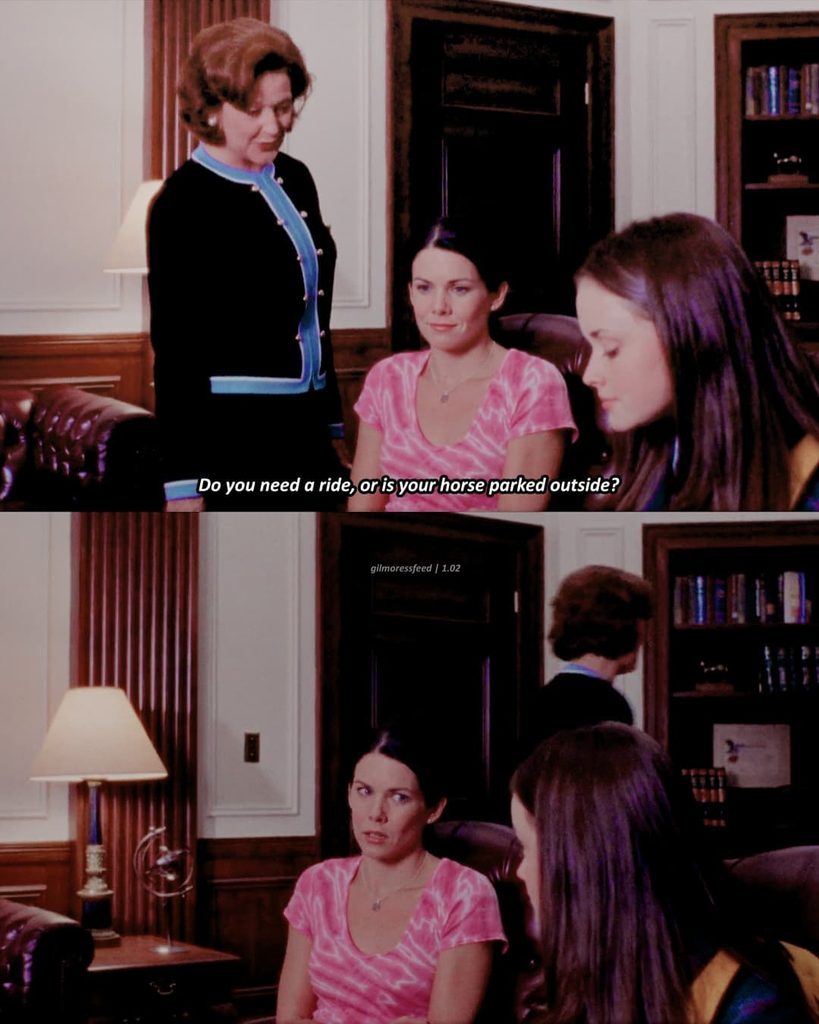
Rory grows up between Lorelai’s unconventional independence and the Gilmore world of tradition, education and expectation.
She can understand both.
That makes her different from Lorelai.
Lorelai often experiences the Gilmore world primarily as something she escaped.
Rory experiences it partly as something she gained access to.
That dual identity follows her into adulthood.
So if Rory becomes a mother, she is not starting from the same emotional map Lorelai had.
She carries more than one inheritance.
The final words force us to imagine a fourth generation
Emily.
Lorelai.
Rory.
And potentially Rory’s child.
Suddenly the story becomes larger than the original mother-daughter pair.
What patterns continue?
Which ones disappear?
Would Rory parent like Lorelai?
Would she become more structured than Lorelai expected?
Would Emily’s influence somehow survive another generation?
The show stops before answering.
That is exactly why the ending stays alive in fandom discussion.
A cycle is not the same thing as a destiny
This distinction matters.
Rory becoming pregnant does not prove that she “became Lorelai.”
Families repeat circumstances without repeating outcomes.
The same event can mean something completely different depending on the person experiencing it.
Perhaps that is the more mature interpretation of the ending.
Lorelai’s story does not trap Rory.
It gives Rory context.
The final scene is really about inheritance
Not money.
Not Yale.
Not even pregnancy alone.
Emotional inheritance.
What do daughters carry from their mothers?
What do they reject?
What do they accidentally repeat?
What do they understand only after becoming adults themselves?
Gilmore Girls asks those questions from its first episode.
The final four words simply make them impossible to ignore.
Do you see Rory’s pregnancy as history repeating itself—or as the beginning of a completely different story?